- The Athletic Entrepreneur
- Posts
- Not All Athletes Are Built for NIL—Because NIL Is a Business, Not a Sport
Not All Athletes Are Built for NIL—Because NIL Is a Business, Not a Sport
Why programs are leaving NIL money on the table by misidentifying which athletes actually drive value

Michael Kennedy
April 22, 2026
In partnership with

Here’s your lifeline.

Another headline. Another client pays late. The next 10 days shift. You open your bank app before walking into the office.
The hits just keep coming right now.
And as the leader, you’re the one absorbing all of them.
But survival doesn’t come from holding tighter alone.
The Small Business Survivor Guide gives you 83 practical ways to cut costs, stabilize cash flow, and navigate economic pressure with confidence.
Because in times like these, stability isn’t luck. It’s strategy.
And the leaders who stay standing are the ones who prepare for what’s next.
Not All Athletes Are Built For NIL
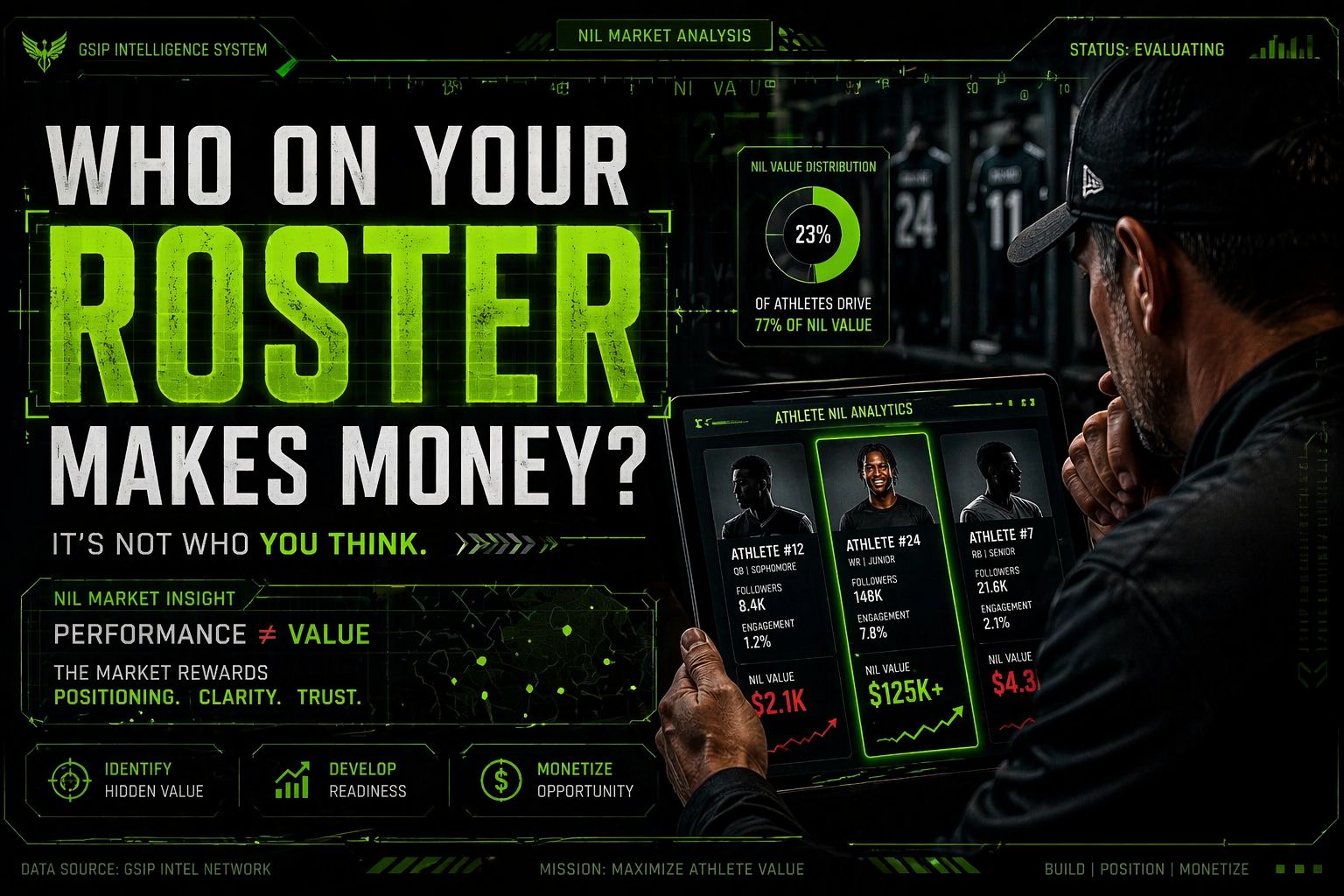
Why lower-performing athletes are out-earning higher-performing ones in the same market?
Let me show you a mispricing.
This week I came across an Instagram profile:
A Division I football player. Around 100K followers. 98 posts.
Almost no highlights.
No mixtapes. No game clips. No “look at me” performance content.
Instead:
faith
family
fatherhood
the daily reality of being a student-athlete
Within ten seconds, you understand exactly who he is.
That clarity is converting into money.
Brands are paying him.
There are better athletes than him.
Faster. Stronger. More productive.
They’re making less.
Why?
Because NIL is not a performance-based system.
It’s a marketplace driven by attention, alignment, and asset clarity.
And most athletes are mispriced.
Athletes still believe one thing:
“If I perform, the money will come.”
That was true in a contract-driven system.
It is not true in an open market.
In NIL:
performance gets you seen
positioning determines what you’re worth
If your only signal is “I’m good at my sport,” you are a commodity.
And commodities don’t command premium pricing.
Brands are not buying your highlights.
They are not even buying your followers.
They are buying:
audience trust
identity alignment
conversion potential
They’re asking one question:
If we attach our product to this athlete, does it make sense—and does it sell?
The athlete I mentioned earlier isn’t just a football player.
He’s a clearly defined asset:
faith-driven
family-oriented
disciplined
That opens multiple categories:
family brands
lifestyle products
faith-based companies
That’s not content.
That’s market access.
Meanwhile, most athletes are running highlight pages.
Posting performance clips.
Competing in a saturated lane with thousands of identical profiles.
Same signals. Same positioning. Same outcome:
low leverage
low pricing power
no deals
Here’s the real question:
If a brand wired you $10,000 today…
What exactly are they buying?
Not your stats.
Not your potential.
The are buying your ability to move an audience.
If you can’t define that clearly, you are not priced—you’re guessed.
And in any market, guesswork gets discounted.
Identity is an asset.
Most athletes treat it like expression.
High-performing athletes treat it like infrastructure.
Because in NIL:
identity creates signal
signal builds trust
trust drives conversion
conversion generates revenue
No signal. No trust. No money.
This is where the real separation happens.
It’s not about posting more.
It’s about understanding how the system works:
how attention is priced
how brands evaluate risk
how identity creates leverage
That’s a thinking advantage.
And almost no one is training it.
Athletes spend thousands of hours training physically.
Almost zero time training:
decision-making
pattern recognition
positioning strategy
That’s the gap.
Because NIL is just another system.
And systems reward the athletes who understand how they work.
That’s where GSIP fits in.
If you want to compete in a market like this, you need to train the part of your game that actually drives value.
The mental side.
The strategic side.
The decision-making layer.
Here’s your assignment:
What is your identity in one sentence outside of your sport?
What category of brands naturally fits into your life?
What proof does your content give that this is real?
If you can’t answer those, the market can’t price you.
Final reality:
NIL didn’t create opportunity.
It exposed who understands leverage.
Right now, there are athletes with less talent, less production, and less upside earning more than you.
Not because they’re better.
Because they’re positioned.
If you want to stop being undervalued, start training the part of your game the market actually rewards.
We built a system designed to train decision-making, pattern recognition, and strategic thinking.
Five reps a day.
Because in this market, the athletes who think better get paid first.
FIND OUT IF YOU’RE ACTUALLY NIL READY
Start here https://gsip.pro/daily-training (image below)
Scroll down. click NIL READINESS —> Select 3-Day Free Trial
(Over thr course of 3-days it sends 5 questions daily to you/your athlete's inbox)
Then scroll down. Enter you or athlete's name + email address, to mail the daily training solution
Welcome letter hit your inbox
Daily training start.

Athletic Entrepreneur Intelligence Brief
Issue No. 112 | April 16, 2026
Covering the business of sports and the modern athlete economy.
© 2026 Athletic Entrepreneur Intelligence Brief. All rights reserved. The analysis, commentary, and intellectual content contained in this publication are the sole property of Athletic Entrepreneur. Reproduction or redistribution without written permission is prohibited.