- The Athletic Entrepreneur
- Posts
- THE TRANSFER PORTAL DIDN’T BREAK COLLEGE SPORTS. IT EXPOSED THE NEW MODEL.
THE TRANSFER PORTAL DIDN’T BREAK COLLEGE SPORTS. IT EXPOSED THE NEW MODEL.
What looked like chaos after the championship was something else: a live market moving at full speed.

Michael Kennedy
April 10, 2026
In partnership with

What looked like chaos after the championship was something else: a live market moving at full speed.
Michigan had its moment.
Then the sport moved on.
The confetti had barely settled before the transfer portal opened.
By late the next morning, over 1,200 players had already entered. The window closes April 21.
Fifteen days.
That’s the entire decision window now.
This isn’t offseason anymore.
This is a market.
THE GAME HAS BEEN COMPRESSED
The NCAA shortened the portal window to create order.
Instead, it created pressure.
Everything now happens at once:
roster decisions
NIL conversations
recruiting calls
exit strategies
replacement plans
Compressed into two weeks.
And pressure changes behavior.
Players enter early to stay flexible.
Coaches move fast before options disappear.
This isn’t patience.
This is urgency.
CONTINUITY IS NO LONGER THE DEFAULT
Tennessee’s women’s program lost its entire returning roster.
All eight eligible players entered the portal.
That’s not just turnover.
That’s a reset button.
And once full resets become possible…
They become normal.
FANS ARE FEELING IT
College sports has always been built on identity.
Not just teams — but players, stories, continuity.
Now?
That continuity is breaking.
Fans aren’t following rosters the same way.
They’re following moments.
The model is shifting from:
attachment → consumption
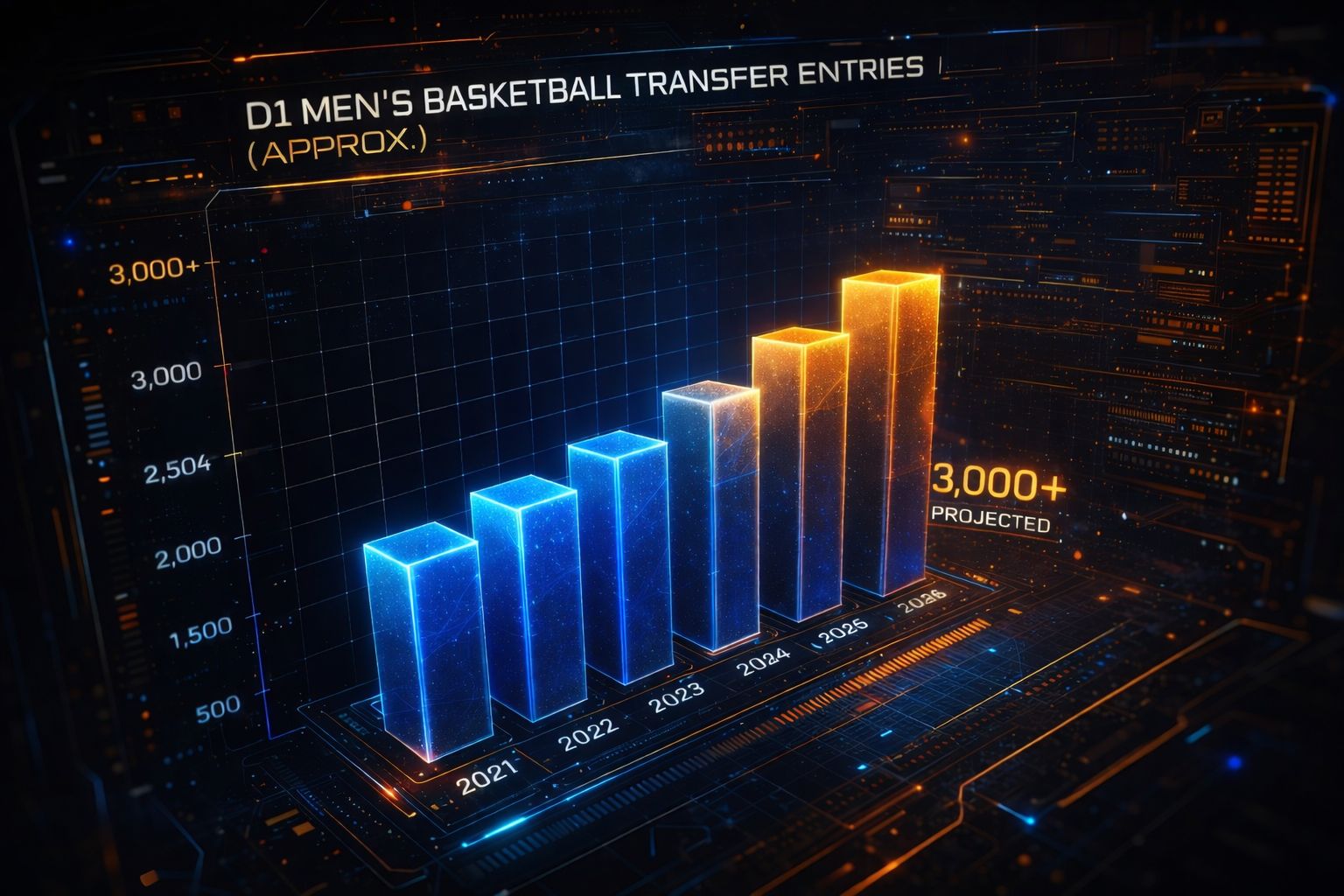
Transfer portal entries aren’t spiking anymore — they’re stabilizing at a new baseline.
THE TALENT PIPELINE HAS CHANGED
Mid-majors used to develop players.
Now they showcase them.
Develop → perform → leave.
At the same time, high school recruiting is getting squeezed.
If a coach has one scholarship left:
Take an 18-year-old project
Or a proven college player?
The answer is becoming obvious.
THE REAL DRIVER: MONEY
The House settlement changed everything.
Schools can now share up to ~$20.5M annually with athletes.
That’s not theory.
That’s structure.
And structure drives behavior.
At the top of the market, players now carry multi-million dollar valuations.
Which creates a new decision:
Stay and build?
Or move and maximize?
For many athletes, college is no longer a waiting room.
It’s an earning window.
THIS IS WHERE MOST PEOPLE MISREAD IT
Everyone is focused on movement.
Too many transfers. Too much chaos.
But that’s surface level.
The real shift is happening underneath:
Decision pressure.
Because now athletes have to process:
fit
role
system
money
exposure
long-term value
Fast. Very fast.
THIS IS NOT JUST BASKETBALL IQ ANYMORE
This is:
Career Intelligence.
Market Intelligence.
Decision Intelligence.
And almost nobody is training it.
THE REAL EDGE
In this environment, the advantage shifts.
Not just to talent.
Not just to skill.
To processing ability.
The players who can:
read situations faster
evaluate opportunities better
make clearer decisions under pressure
…will separate.
On the court.
And off it.
FINAL THOUGHT
The transfer portal didn’t break college sports.
It revealed what it already became:
A fast-moving, high-pressure decision ecosystem.
The old model was built on continuity.
The new model is built on optionality.
And in a system like that…
The athletes who think better
don’t just play better.
They move better.
⸻
Click
Support our partners below — Their tools and platforms helps athletes and operators navigate the new sports economy.
AI Agents Are Reading Your Docs. Are You Ready?

Last month, 48% of visitors to documentation sites across Mintlify were AI agents, not humans.
Claude Code, Cursor, and other coding agents are becoming the actual customers reading your docs. And they read everything.
This changes what good documentation means. Humans skim and forgive gaps. Agents methodically check every endpoint, read every guide, and compare you against alternatives with zero fatigue.
Your docs aren't just helping users anymore. They're your product's first interview with the machines deciding whether to recommend you.
That means: clear schema markup so agents can parse your content, real benchmarks instead of marketing fluff, open endpoints agents can actually test, and honest comparisons that emphasize strengths without hype.
Mintlify powers documentation for over 20,000 companies, reaching 100M+ people every year. We just raised a $45M Series B led by @a16z and @SalesforceVC to build the knowledge layer for the agent era.
And don't forget. 100 pushups per day keeps the cobwebs away